The Engineering Team Said It Would Take Six Weeks
It has been four months. The listing still is not live. Three engineers have touched the project. The lead engineer who understood the AWS Marketplace Metering Service just gave their notice. And your competitor — who listed on marketplace eight months ago — just closed a $1.2M deal through ISV Accelerate that your sales team only heard about secondhand.
This is not a hypothetical. It is the most common story we hear from software companies who tried to build their cloud marketplace integration in-house before eventually deciding to use a platform.
What You Are Actually Building
The phrase cloud marketplace integration undersells the complexity. A complete, production-ready SaaS listing on AWS Marketplace requires: subscription registration webhooks, metering API integration (hourly usage reporting), entitlement service integration, subscription lifecycle event handling, fulfillment URL and onboarding flow, private offer creation workflow, and billing reconciliation.
The Realistic Engineering Cost
Single Marketplace (AWS)
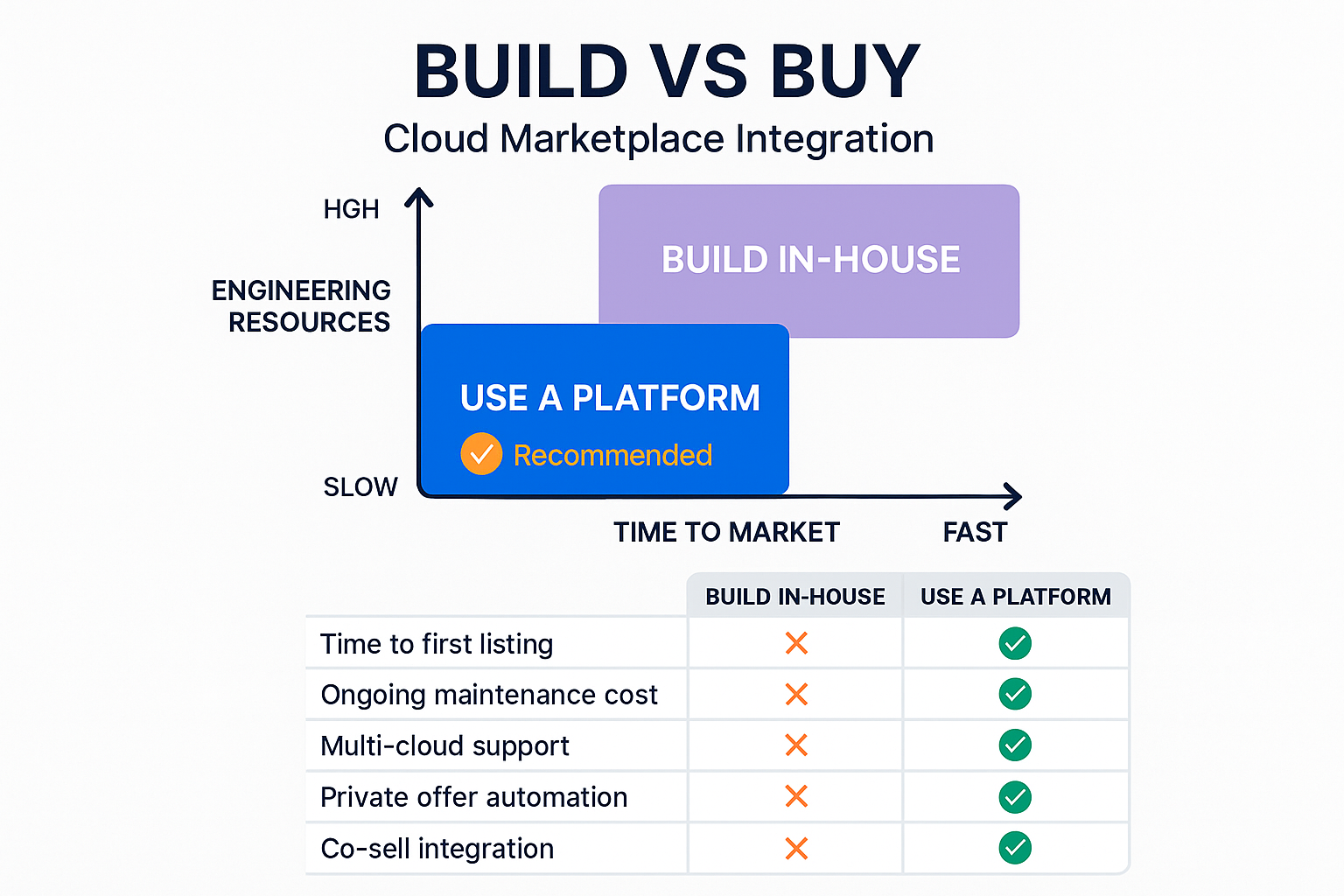
- Initial build: 3–5 months, 2 senior engineers
- Engineering cost: $90,000–$183,000
- Total time to go-live: 5–8 months
- Ongoing maintenance: 0.25–0.5 FTE/year ($45K–$110K)
Three Marketplaces
- Initial build: 10–18 months
- Engineering cost: $300,000–$600,000+
- Ongoing maintenance: 0.75–1.5 FTE/year
Hidden Costs
Product roadmap cost: Engineers building marketplace plumbing are not building product features. Key person risk: Knowledge concentrates in 1-2 engineers who will eventually leave. API evolution risk: Cloud providers regularly update APIs, each requiring engineering attention. Opportunity cost: If build takes 6 months and year-one marketplace revenue is $2M, you lose ~$1M in delayed revenue.
When Building Makes Sense
- 500+ engineers with a dedicated platform team
- Highly unusual technical requirements incompatible with platforms
- Marketplace is a core competitive differentiator in your business model
- You already built it and it works
The Decision Framework
- What is your dedicated engineering capacity for non-product infrastructure?
- How long can you wait to generate marketplace revenue?
- What is your year-one marketplace revenue opportunity?
- How many marketplaces do you need?
- What is your engineering organization's core value creation?
How Automatum Enables the Platform Path
Automatum handles the entire technical integration layer: API connections to AWS, Azure, and GCP; metering infrastructure; subscription lifecycle; private offer workflow; billing reconciliation. Over 60 ISVs have used it to list without building marketplace infrastructure internally — going live in 6–10 weeks instead of 5–8 months.
Visit automatum.io to start the conversation.
No spam. Just the latest releases and tips, interesting articles, and exclusive interviews in your inbox every week.
.svg)